China Top 10 Small Bedroom Storage Ideas to Maximize Space

Time:2026-09-27 Author:Isabella
0%

A small bedroom can feel crowded before the day even begins: a wardrobe door hits the bed, spare bedding spills from a shelf, and the floor becomes a storage zone. In compact urban homes across China, smart storage starts with the room’s actual dimensions—not a picture-perfect makeover. Measure the bed, door swing, window, and walking path. Every inch matters.

The IKEA Life at Home Report 2023 drew on 37,428 respondents across 38 markets to explore how home environments shape daily life. It is not a bedroom-storage survey, but it offers useful context: how a home works matters to people’s everyday experience. Architect Sarah Susanka, author of The Not So Big House, captures that principle: “It’s not how big your house is, it’s how you use it.” For anyone asking how to maximize storage in small bedroom spaces, that means looking beyond another cabinet. Think under-bed drawers, wall-mounted shelves, a tall wardrobe, and furniture that earns its footprint.

This guide presents ten practical ideas, from hidden storage to more deliberate closet layouts. Start with items you use often; keep them within easy reach. Store seasonal pieces higher or farther away, and leave clear paths around the bed. But measure first. A storage bed that blocks a drawer or a shelf that crowds a window can make a small room harder to use. No single trick fits every home. The best solution is the one that holds what you need without making the room feel like a cupboard.
China Top 10 Small Bedroom Storage Ideas to Maximize Space

Measure the Room and Allow About 60 cm for Standard Wardrobe Depth

In a small bedroom, measure the wall before choosing a wardrobe. A standard wardrobe is about 60 cm deep, but handles and sliding tracks may add a little more. Measure from the wall to the furthest point of the doors, not just the cabinet frame. Check skirting boards, window trim, and nearby sockets too. Small details matter.

Mark the proposed wardrobe footprint on the floor with masking tape. Then open the doors and stand where you would dress. Hinged doors need clear space in front; sliding doors avoid that swing, though they still need room for access. Keep a comfortable walking route beside the bed. If the gap feels tight with tape on the floor, it will feel tighter with furniture in place. Try it first.

Measure twice. It helps.

A common planning mistake is treating 60 cm as a guaranteed fit. It is only a useful starting point; room shape and wardrobe design vary. In very narrow rooms, consider a shallower unit, high shelves, or storage beneath the bed, but check that hanging clothes will not press against the doors. I would also recheck measurements after moving the bed. That step is easy to skip, and sometimes the original layout simply needs another look.

Compare 10 Space-Saving Options, from Under-Bed Drawers to Loft Beds

A small bedroom needs storage that respects daily movement. The National Association of Home Builders, analyzing U.S. Census data, reported a median new single-family home size of 2,286 square feet in 2023, down from 2,299 in 2022. That modest decline is not bedroom-specific, but it reflects the value of using space carefully. Under-bed drawers suit folded clothes and spare sheets; rolling bins are cheaper, though they collect dust. Wall shelves keep books off the floor, while a tall, narrow wardrobe uses vertical space. Measure the door swing before buying one.

For tighter rooms, loft beds create room below for a desk or drawers, but climbing down at night is not for everyone. Storage benches hide blankets and provide a perch. Shelved headboards keep a lamp and book within reach, while over-door organizers hold light items without claiming floor space. Fold-down desks can free a wall when work is finished; nesting tables tuck away, and modular cubes adapt as needs change. Small details matter: leave a clear path to the bed, and check drawer clearance against nearby furniture. I would not choose every option at once; too much built-in storage can make a small room feel crowded.

Use Bed-Base Clearance of 15–25 cm for Accessible Under-Bed Storage

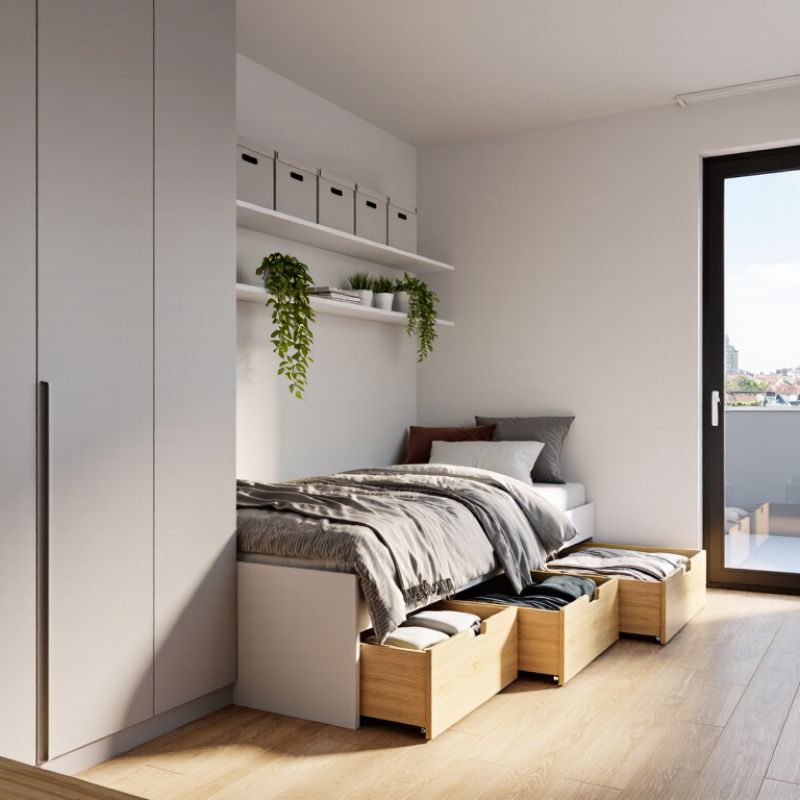
In a compact Chinese bedroom, the gap beneath the bed can become useful storage instead of a dusty dead zone. China’s National Bureau of Statistics reported urban per-capita housing floor area of 38.6 m² in 2022, a reminder that every square metre matters. Measure from the floor to the bed’s lowest rail, then look for 15–25 cm of clear height. Leave 2–3 cm extra so containers slide out easily. Small detail. Big difference. Low, lidded bins with smooth wheels work well for spare towels, linens, or seasonal clothes. Soft zip bags can fit around bed legs and rails.

Measure the opening’s width and depth, too; clearance alone does not guarantee a container will fit. Keep frequently used items near the edge, and label bins where you can see them. Store only dry textiles, and avoid blocking any airflow beneath the mattress. Bed frames vary, so 15–25 cm is a practical planning range, not a universal standard. This is easy to overlook. An overfilled bin may fit once, then jam each morning. Leaving a little unused space is often more useful than squeezing in one extra item.

China Top 10 Small Bedroom Storage Ideas to Maximize Space Use Bed-Base Clearance of 15–25 cm for Accessible Under-Bed Storage
No. Storage Idea Suggested Setup or Size Best for Space-Saving Benefit Access Tip
1 Low-profile under-bed bins For 15–25 cm of bed-base clearance, choose bins about 10–22 cm high, leaving room for easy movement. Seasonal clothes, spare bedding, and shoes Uses the footprint beneath the bed without adding furniture to the floor area. Measure the narrowest clearance point, including bed supports; choose bins with handles.
2 Under-bed drawer units Select drawer height to suit the available clearance; allow extra room for casters or drawer movement. Frequently used clothing and accessories Turns otherwise unused space into organized, divided storage. Keep the drawer opening facing an unobstructed side of the bed.
3 Bedside wall shelves Use a narrow shelf above or beside the bed, positioned within comfortable reach. Books, glasses, a phone, and small daily essentials Moves bedside items off the floor and can replace a bulky nightstand. Secure shelves to a suitable wall fixing and keep heavy objects away from the bed edge.
4 Over-door hooks or hanging organizer Choose a slim organizer that fits the door and leaves it able to open and close fully. Bags, scarves, belts, and lightweight accessories Uses the back of a door rather than valuable floor space. Check the clearance between the door, frame, and nearby furniture before fitting.
5 Wardrobe door organizers Use shallow pockets or hooks sized to the available door depth. Small accessories, folded items, and everyday essentials Creates storage on an often-unused vertical surface. Keep the organizer slim enough that wardrobe shelves and doors still operate smoothly.
6 Vertical drawer dividers Fit adjustable dividers inside existing drawers; arrange items in compact rows. Socks, underwear, T-shirts, and small accessories Makes existing drawer space easier to use without adding another storage unit. Measure the inside width and depth of each drawer before choosing dividers.
7 Stackable closet boxes Use boxes that fit the shelf depth and can be reached without unsafe stacking. Off-season clothing, linens, and infrequently used items Uses the vertical space inside a wardrobe or closet. Place heavier boxes lower and label the front for quick identification.
8 Storage ottoman at the bed end Choose a compact ottoman that leaves a clear walking route around the bed. Blankets, spare pillows, or items used regularly Combines a seat or surface with concealed storage. Check the lid’s opening space and avoid blocking drawers or the bedroom door.
9 Hooks on unused wall space Arrange a small row of hooks at a convenient height, away from narrow walkways. Frequently worn clothes, robes, and lightweight bags Gets everyday items off chairs and floors while using vertical space. Use fixings appropriate for the wall surface and the intended load.
10 Foldable laundry hamper Choose a slim or collapsible hamper sized for the available corner or closet space. Dirty laundry and worn clothing Contains laundry without requiring a large permanent floor footprint. Place it where it does not obstruct the bed, wardrobe, or room entrance.

Measurement note: Suggested dimensions are planning guidelines, not fixed product standards. Measure the bed’s actual clearance and the room’s available space before purchasing storage items.

Plan Shelves at 30–35 cm Deep for Everyday Bedroom Items

A 30–35 cm shelf depth gives small bedrooms useful storage without letting shelves dominate the room. That is roughly 12–14 inches. It suits folded T-shirts, jeans, small linen baskets, and books. Measure your own items first; bulky sweaters may need more room. Leave a little space at the front, too, so objects are easy to grasp rather than wedged against the wall. Short shelves above a desk or beside a bed can hold daily essentials, while taller units make use of vertical space. Check door swings and walking clearance before fixing anything in place. A shelf can be practical and still feel awkward.

For a built-in, try 30 cm for lighter items and 35 cm where baskets or thicker bedding will sit. Keep frequently used objects between waist and eye level; reserve the highest shelf for occasional items. The U.S. Environmental Protection Agency’s 2018 Advancing Sustainable Materials Management report estimated that 12.1 million tons of furniture and furnishings were generated as municipal solid waste, with 80.1% landfilled. This figure does not show that built-in storage prevents waste. Still, measuring first may help avoid buying a bulky cabinet that does not fit the room—or the things you actually own.

China Top 10 Small Bedroom Storage Ideas to Maximize Space

Recommended shelf depth for everyday bedroom items: 30–35 cm

A shelf depth of 30–35 cm is a practical planning range for folded clothing, books, bedding, accessories, and daily-use bedroom items. Shallower shelves help preserve walking space, while 35 cm shelves provide additional capacity for bulky storage.

Rank Storage Ideas by Capacity, Floor Space Saved, and Installation Cost

China Top 10 Small Bedroom Storage Ideas to Maximize Space

For small bedrooms, storage must be judged by capacity, floor space saved, and installation cost. Rank 1 is a full-height wardrobe with adjustable shelves. It offers very high capacity, saves nearly all floor space, and costs moderately to install. Rank 2 is under-bed storage, which provides high capacity without using walking space. Installation is usually low-cost. Rank 3 is a wall-mounted cabinet, saving substantial floor area with medium-to-high capacity. However, secure wall fitting requires professional care.

Rank 4 is a storage bed with built-in drawers. It combines sleeping and storage functions, but installation costs can be higher. Rank 5 is a narrow corner shelf, which uses awkward space efficiently and costs little. Rank 6 is a door-mounted organizer, offering medium capacity and excellent floor savings. Rank 7 is a floating bedside shelf, with low capacity but almost no floor impact. Rank 8 is stackable storage boxes, which are affordable and flexible. Rank 9 is a clothes rail with lower shelves. It is practical, though it may look untidy. Rank 10 is a folding stool with hidden storage, saving limited space at low cost.

Tips: Measure door clearance, bed height, and wall strength before buying. Leave a clear walking path of at least 60 centimeters. Lightweight boxes are safer on high shelves. In my experience, under-bed drawers work best when used weekly. Seasonal items can stay higher. I once overfilled a wall cabinet, and the doors became difficult to open. Storage capacity is not everything. Convenience matters.

FAQS

How deep is a standard wardrobe?

About 60 cm is a useful starting point. Handles and sliding tracks may add extra depth, so measure the furthest point.

What should I measure before choosing a wardrobe?

Measure the wall, skirting boards, window trim, and nearby sockets. Check the bed’s position, too. Small details matter.

How can I test whether a wardrobe will fit?

Mark its footprint on the floor with masking tape. Open the doors and stand where you would get dressed. Try it first.

Do hinged or sliding doors work better in a small bedroom?

Hinged doors need clear space to swing open. Sliding doors avoid that swing, but still need room for access.

How much space should I leave beside the bed?

Keep a comfortable walking route. If the taped layout already feels tight, furniture will probably make it feel tighter.

What shelf depth works for everyday items?

Shelves around 30–35 cm deep suit folded clothes, books, and small linen baskets. Measure your own items; bulky sweaters may need more room.

Where should I place frequently used items?

Keep daily essentials between waist and eye level. Save the highest shelf for occasional items. Easy to reach.

What can I do if a 60 cm wardrobe is too deep?

Consider a shallower unit, high shelves, or storage under the bed. Check that hanging clothes will not press against the doors. Recheck after moving the bed; I might skip that step, but it can change the layout.

Conclusion

Making a small bedroom feel organized starts with accurate measurements. Allow about 60 cm for a standard wardrobe’s depth, then consider how doors, drawers, and walkways will fit around it. This guide compares 10 space-saving ideas, from under-bed drawers and wall shelves to multifunctional furniture and loft beds, to help you decide how to maximize storage in small bedroom spaces without overcrowding the room.

For easy access to items stored beneath the bed, look for bed-base clearance of around 15–25 cm. Everyday bedroom items can fit neatly on shelves about 30–35 cm deep, depending on what you need to store. The ideas are ranked by storage capacity, floor space saved, and installation cost, making it easier to choose practical solutions that match your room’s layout and budget.

Isabella

Isabella

Isabella is a dedicated marketing professional with a sharp focus on driving brand growth and engagement through strategic content creation. With an extensive background in digital marketing, she combines her passion for storytelling with her keen understanding of industry trends to deliver......